

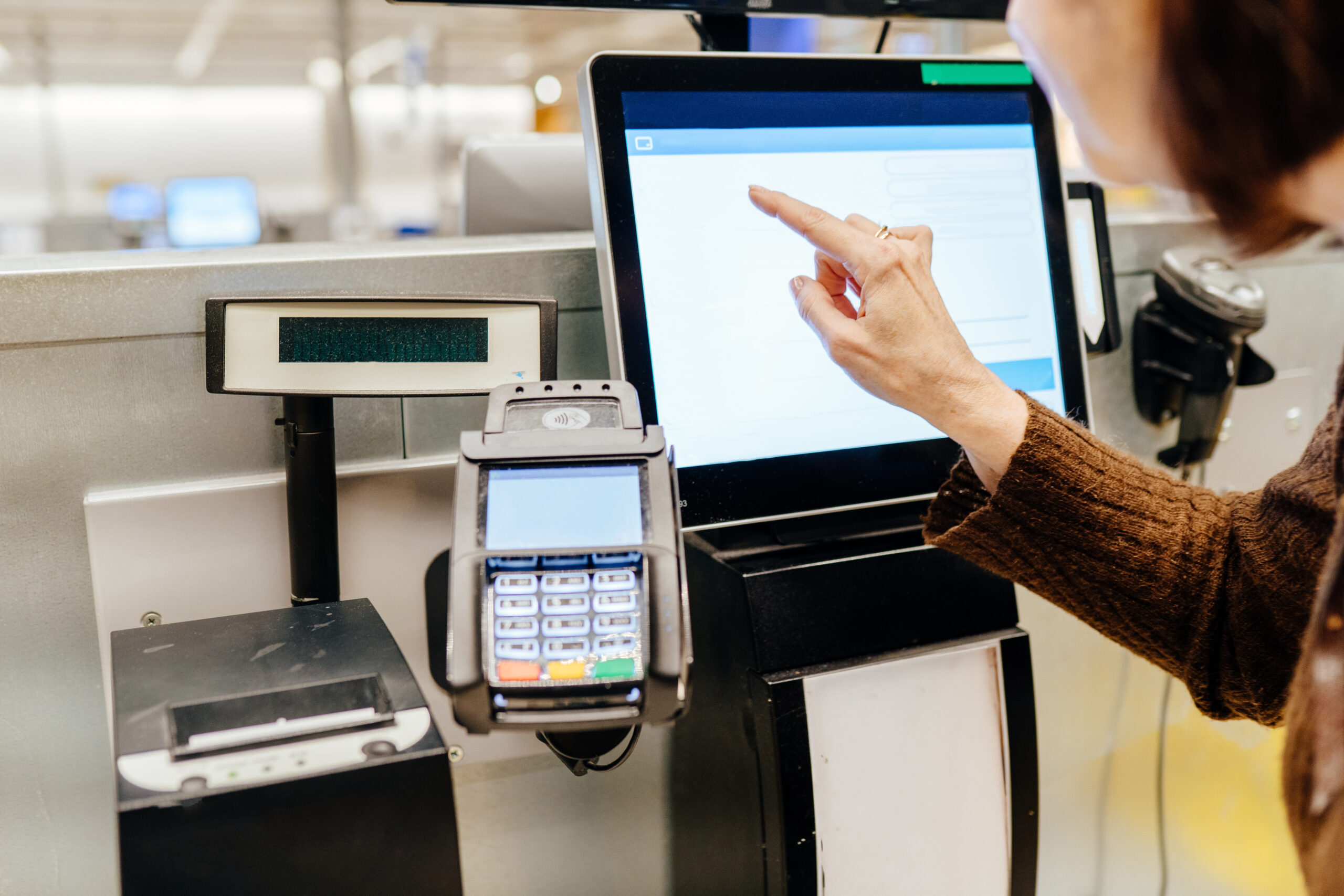
Conventional retail banking today demands convenience, speed, and seamless service on the part of customers. Most in-branch interactions, however, still demand queuing, paperwork, and manual back-office processing. In a national retail bank, this friction limited how quickly customers could initiate service requests and how efficiently staff could process them.
We addressed this by designing and developing a POS-based service-requesting application, which enables customers to initiate banking services directly at the terminal, thus drastically improving the uptake of the services while reducing operational effort behind the scenes.
The Challenge: Slow Service Initiation and Manual Back Office Work
Notwithstanding investments in digital banking, the bank’s branches still relied on traditional processes for routine service requests. That has caused a number of issues:
– Long wait times for customers seeking simple service activations such as KYC updates, cheque requests, card reissuance, reset PINs, etc.
– Manual entry of requests by personnel raises the chances of processing errors and increases overall workload.
– Poor cross-sell and service uptake, as the frontline associates were not well equipped to prompt or guide customers.
– No single unified system exists to capture, route, and track service requests in real time.
With thousands of POS terminals in branches and at partner locations, the bank needed a scalable way to turn each terminal into a service initiation touchpoint without redesigning existing hardware.
Our Solution: POS App for Instant Banking Service Requests.
We developed a multi-platform POS service request application that converts the terminal into a secure, guided interface through which customers can request banking services in just a few seconds.
- Simple, Guided Customer Flow
- Customers choose a service directly on the POS terminal.
- The device captures the required inputs: ID, account number, service type.
- The service requests are immediately sent to the bank’s backend for processing.
- It eliminated dependency on paper forms and reduced customer waiting time.
- Real-time Integration with Bank Systems
- We integrated the POS application with the bank’s core systems and workflow engine using secure APIs:
- Requests are automatically routed to the correct operations team.
- Customers receive immediate confirmation slips or SMS.
- Staff are no longer required to manually re-enter information.
- Secure and Compliant by Design
- Encrypted data capture and transmission
- Tokenized identifiers
- Role-based access for staff-assisted flows
- Full audit logging for compliance reviews
- Scalable Across Thousands of Terminals
Because it was built as a lightweight cloud-managed application, the bank could deploy it across all branches and partner merchant locations with minimal configuration.
Summary
Today, this POS app is used throughout the bank’s branch and merchant network to trigger service requests in real-time, minimizing customer friction and speeding up operations.
Rather than standing in line, customers initiate services directly from the terminal and the workflow engine of the bank processes requests digitally, thereby increasing the level of accuracy and reducing manual workload for branch staff.
Business Impact
- Higher service adoption: When the process is intuitive and fast, customers are more likely to request more services.
- Faster in-branch operations: Branch queues shrink, and staff can focus on advisory tasks rather than form-filling.
- Operational Efficiency: Automated request routing simplifies back-office processing.
- Consistency across locations: Each branch and merchant touchpoint now operates the same digital process.
- Scalable deployment: The lightweight application operates unfailingly across thousands of terminals.
Key Takeaways
- Self-service is a fantastic way to improve customer experience. The ability for customers to initiate services themselves leads to better engagement and satisfaction.
- Digitizing requests removes friction. Automation reduces errors and speeds up fulfillment.
- More than processing payments, a POS terminal has the capability to become a powerful service and engagement tool.
- Scalability matters. Cloud-managed apps ensure fast, centralized updates across thousands of devices.
Conclusion
We helped the bank transform its POS terminals into high-value service initiation touchpoints, improving customer convenience and operational efficiency. The result is a faster, more efficient branch experience supported by a digital workflow that scales effortlessly. The project illustrates how modern POS innovation can extend the reach of financial services beyond payments and turn regular terminals into customer-centric service platforms.